Court NewsLatest News
Justice at Last: Huruma Building Owner Jailed for 7 Years Over 52 Deaths
"He was reckless in that he constructed the building without securing all the necessary approvals, and also negligent in disregard for the safety of others," said the Magistrate.

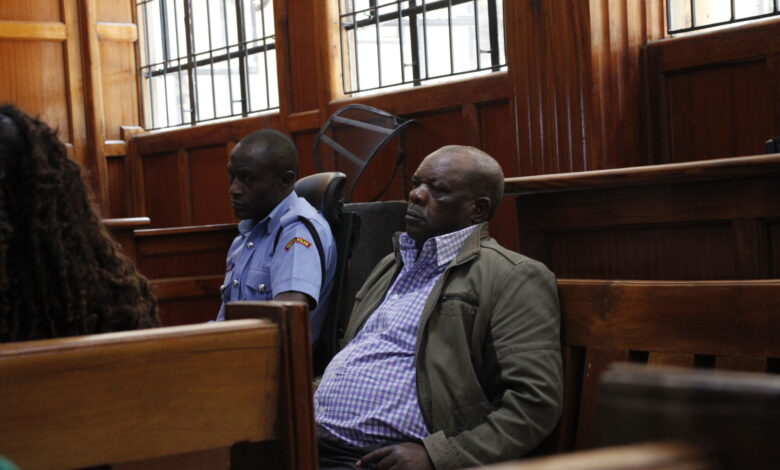
The Nairobi court has sentenced the owner of the building that collapsed a decade ago in Huruma, Nairobi county, claiming the lives of 52 individuals to seven years imprisonment without an option of a fine.
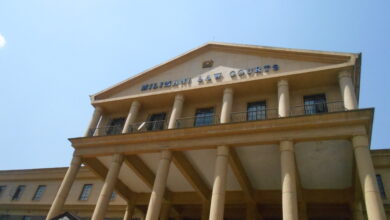
Appearing virtually in a Milimani court, Senior Principal Magistrate Gilbert Shikwe sentenced Samuel Kamau Karanja, the owner of the said building, to seven years imprisonment without an option of a fine.
While delivering the sentence, the Magistrate stated that “the mitigation provided can only help to lessen the custodial sentence but not to avoid it. By considering all the factors, I hereby sentence the convict thereof to a seven-year custodial sentence.”
Karanja was convicted under the 31 counts of manslaughter which he will serve seven years, carrying out development within the area of local authority without permission contrary to Sections 30(1) as read together with Section 30(2) of the Physical Planning Act and unlawful occupation to public land contrary to Section 155(1) as read together with Section 157(2) of the land Act which he will serve 5 and 3 years respectively. The sentence will run concurrently.
Considering the evidence tendered before the court, It was clear that the convict was the owner of the building that collapsed, despite his denial of the same.
The court noted that “the building was built on a riparian reserve at zero distance on the river bank, whereas it was supposed to be constructed at least six metres away. It was built on public land without a title.”
The court also noted that the building did not have the necessary approvals from relevant government authorities, including the National Environment Management Authority, NEMA and the Water Resources Management Authority, WARMA.
“It was also reckless that when the building started exhibiting cracks in 2016, the caretaker was alerted by the tenants, and he only applied cement to patch the cracks, oblivious to the calamity that was unfolding,” the Magistrate stated.
He added that the death of the 52 souls that were residing in the said building was caused by actions that bordered on illegality, lawlessness, recklessness and negligence on the part of the owner of the building.
“He was reckless in that he constructed the building without securing all the necessary approvals, and also negligent in disregard for the safety of others,” said the Magistrate.
In defence, Karanja denied all the charges levelled against him and also denied owning a plot in the area of Ngei Estate 2, but he owns a plot around Mathare United.
He admitted having property around the area on genuine land, but the house that collapsed did not belong to him.
“I was at home in Murang’a, and two days later, I saw my face on the screen, which made me surrender to the police,” he stated.
Karanja denied the victims were his tenants, asserting that they were not known to him and that he had no claim to that property, and he did not know why he was charged with that crime.
In analysing the matter, the Magistrate considered the testimony of Bibiana Rabuku, the surveyor who originally surveyed the land and did the deed plans on 19/4/1996, who confirmed the building was in the riparian area.
Though there was no direct evidence of ownership of the said plot in the form of a title deed, the Magistrate stated that there exists circumstantial evidence to shed light on who the owner is.
He considered the evidence of Juma Ali Amir, an assistant chief in the area, who told the court that the construction of the building commenced in 2013. When he saw people digging the foundation, he consulted his senior chief, and he told the workers to stop digging the trenches.
“The first accused person confronted me and threatened to go to his seniors, the DO and DCs, due to his interference.”
One tenant in his evidence told the court that he used to see Karanja come and speak to the caretaker.
Another witness, Victor Abukar of KPLC, testified that he approved the electricity to the building that collapsed. He told the court that he made the application on behalf of Samuel Kamau Karanja.
“Pointing out the above testimony of these six witnesses, it wholesomely and cumulatively points to the first accused as the owner of the building that collapsed,” the magistrate pointed out.